Molecular and Materials Modelling (MMM)
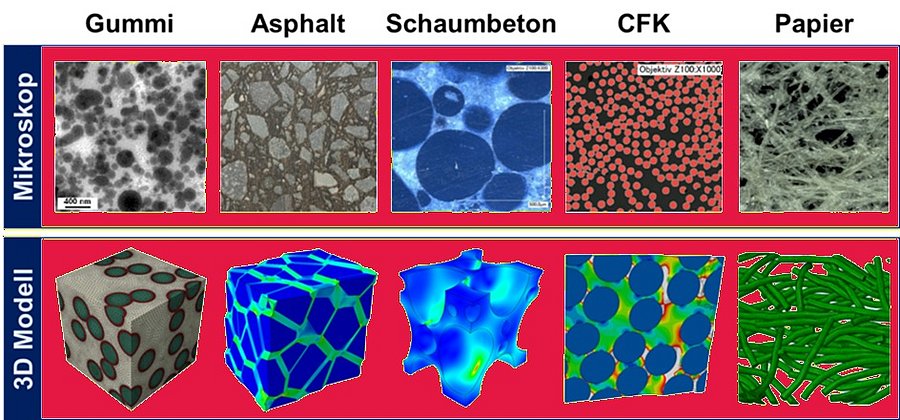
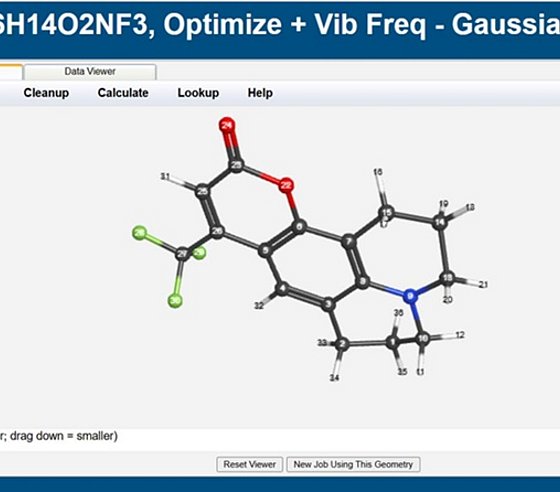
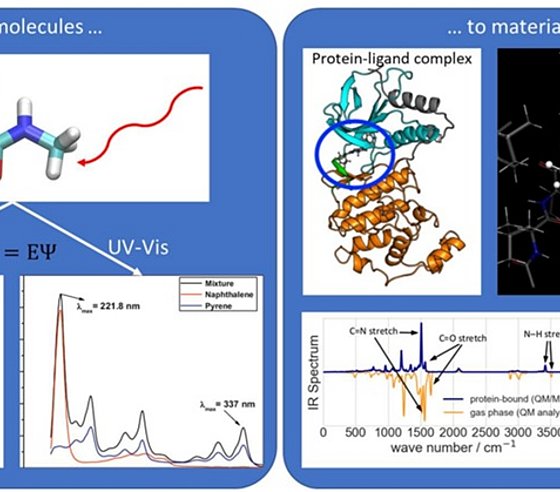
Are you fascinated by how quantum mechanics and thermodynamics shape the properties of molecules and materials—from atoms to advanced functional systems? In the Molecular and Materials Modelling specialization, you’ll explore methods from Schrödinger’s equation and density functional theory to molecular dynamics simulations, working with powerful tools such as GROMACS, LAMMPS, and TURBOMOLE. If you want to connect microscopic theory with macroscopic material properties using state-of-the-art computational techniques, this specialization is your perfect choice!
Description of the Specialization
Students are able to describe material properties from the microscopic to the macroscopic scale. They are acquainted with the fundamental concepts of quantum mechanics, thermodynamics and essential knowledge in quantum chemistry and statistical thermodynamics. Students study such topics of the Quantum Chemistry, as quantum mechanics, atomic structure and model systems; Electronic structure theory: approximations and methods (Hartree-Fock / post-HF / Density functional theory); Discretization techniques for the solution of the electronic Schrödinger equation; Computation of molecular properties (Structures, band gaps, spectroscopic properties, etc.); Statistical Mechanics & Molecular Dynamics; Fundamentals of thermodynamics & statistical mechanics to understand ensemble properties; Molecules without QM: Learn how to use molecular force-fields; Practical approach to simulation techniques: Monte-Carlo & Molecular Dynamics simulations. Students apply Jupyter notebooks on concepts of molecular dynamics, force fields and quantum chemistry.
Module 1. Molecular and Materials Modelling 1 (MMM1) – mandatory
Workload: 8 ECTS (240 hours, 1 semester)
Final assessment: 30-minutes oral exam, not restricted in attempts
Components:
• Atomic and Molecular Structure (MMM1-a)
- Basic Quantum Mechanics, Wave Functions, Operators, Expectation Values
- Time-Independent Schrödinger Equation
- Particle in a Box, Quantum Harmonic Oscillator, Hydrogen Atom
- Variational Principle
- Born-Oppenheimer Approximation
- Chemical Bonding: Valence Bond and Molecular Orbital Theory
- The Hückel Approximation
• Macroscopic Materials Properties (MMM1-b)
- The Three Laws of Thermodynamics
- Temperature, Entropy and Thermodynamic Potentials
- Applications of Thermodynamics: Phase Transitions, vdW EOS, Osmotic Pressure
- Kinetic Theory
- The Gibbsian Ensemble and Liouville's Theorem
- The Maxwell-Boltzmann Distribution
- Microcanonical, Canonical and Grandcanonial Ensembles
- Monte Carlo Simulations (possible exercise: van der Waals fluid)
• Seminar on molecular and materials properties (MMM1-c)
The student will present a current paper or selected topic with relevance to molecular or materials modelling in a short seminar. Successful completion of this component is required for the registration to the module´s final exam.
• Exercises on Quantum Chemistry and Thermodynamics (MMM1-d)
The fundamental concepts of quantum chemistry, and classical and statistical thermodynamics from the components MMM1-a and MMM1-b will be practiced in dedicated exercises.
Module 2. Molecular and Materials Modelling 2 (MMM2) – mandatory
Workload: 8 ECTS (240 hours, 1 semester)
Final assessment: 60-minutes presentation with colloquium, not restricted in attempts
Components:
• Methods in Molecular and Materials Modelling (MMM2-a)
- Linear Combination of Atomic Orbitals
- Hartree-Fock (HF) Approximation
- Post-HF Methods
- Periodic Boundary Conditions
- Basis Sets: Plane Waves, Atom-Centered Gaussian
- Kohn Sham Density Functional Theory (DFT)
- Potential Energy Surfaces
- Vibrational Analyses: The Hessian
- Electronically Excited States With Linear-Response Time-Dependent DFT
- Continuum Models for Solvation
- Molecular Dynamics (MD) Algorithms
- Born-Oppenheimer and Car-Parrinello MD
- Empirical Force Fields
- Multiscale Simulations
- Free Energy Methods
- Methods for Kinetics
• Practical Molecular and Materials Modelling (MMM2-b)
Selected applications of the methods introduced in component MMM2-a using modern software, e.g.:
- Turbomole
- Pyscf/Psi4 (Python Coding)
- CPMD
- Gromacs
- LAMMPs
- Visualization Software
Working on a project using the practical methods learned. The project will be documented and presented in the form of a poster (including an abstract).
At least 24 ECTS credits (or 13% of completed Bachelor´s degree) in the following fields: Physical Chemistry (including Introductory Thermodynamics), Modern General Physics.
For studying the MMM2 module students should be familiar with contents of the MMM1 module.
You can check yourself, if you can study on this specialization by completing the:
Graduates of this specialization are prepared for careers in materials science, chemical and pharmaceutical industries, nanotechnology, energy research, and computational chemistry. They find employment in industrial R&D departments, research institutes, and companies developing new materials, catalysts, batteries, semiconductors, or molecular compounds.
Typical positions include Computational Chemist, Materials Simulation Engineer, Molecular Modelling Scientist, R&D Scientist, Quantum Chemistry Specialist, and Scientific Software Developer. Alumni work on electronic structure calculations (e.g., Hartree–Fock, DFT), molecular dynamics and Monte Carlo simulations, prediction of molecular and material properties, and multiscale modelling from atomistic to macroscopic levels.
The specialization also provides strong preparation for doctoral studies and research careers in computational chemistry, materials modelling, condensed matter physics, and molecular simulation.
TBA
Gallery
Contacts
Person responsible for the specialization:
Prof. Dr. Hilke Bahmann, +49 202 439 2468, bahmann[at]uni-wuppertal.de
Lecturers:
- Prof. Dr. Hilke Bahmann (bahmann[at]uni-wuppertal.de) – Molecular and Materials Modelling
Links:
Website of the Physical and Theoretical Chemistry Department
Last modified: 25.03.2026